Receivables and cash posting
Flooring receivables, billed and posted.
For flooring contractors and their controllers: how completed work goes unbilled, how a payment lands on the wrong invoice, and how to read an A/R aging you can trust.
Where flooring receivables slip.
- A job finished, marked complete late or never, so it never bills.
- An invoice billed but never booked, so it is missing from the ledger your owners read.
- A builder check covering forty invoices, posted on account instead of to each invoice.
- A short pay left as an open balance, when the difference was a back charge or a deduction.
- A deposit sitting as a credit while the same customer shows past due.
Each one makes the aging wrong in a different direction. Collections then chase money that was already paid, and miss money that was never billed.
Bill what is done, on the day it was done.
The clean rule is to bill each order on its completed date, so the revenue lands in the month the work was done. What stops an order is usually a known reason: no PO, an EPO not yet issued, a hold note, a job not fully complete. Write those reasons down as rules. Then every completed order is either billed or held with its reason, and nothing sits unbilled without one.
Post cash to the invoice it pays.
Cash application means matching each payment to the invoices it covers. Work from the remittance, not the check total. Match on the invoice number or the PO, and keep POs as text so leading zeros survive. When a line is short, record why: a back charge, a deduction, a disputed price. Anything left unapplied at the end of the day goes on a list with a name beside it.
Read the aging every week.
An A/R aging groups open balances by how long ago they were billed: 0 to 30, 31 to 60, 61 to 90 and over 90 days. Read it by customer, and for multifamily by property. Before chasing anything, check it is real: not a payment on account, not a deposit, not a credit that belongs to another job. Commercial retainage belongs in the aging as its own receivable.
What Bearwall sets up.
On your own system, set up for you and checked in a read-only month first:
- Billing completed orders on their completed dates, each held order with its reason.
- Booking what was billed.
- Cash posting against the right invoices, with any line that does not match held for a person.
- An A/R aging and a morning board your team can ask: “Who owes us the most?”
Drafts for follow-up mail are scoped in the diagnosis; a person at your company reviews and sends them. Every write is checked before and read back after.
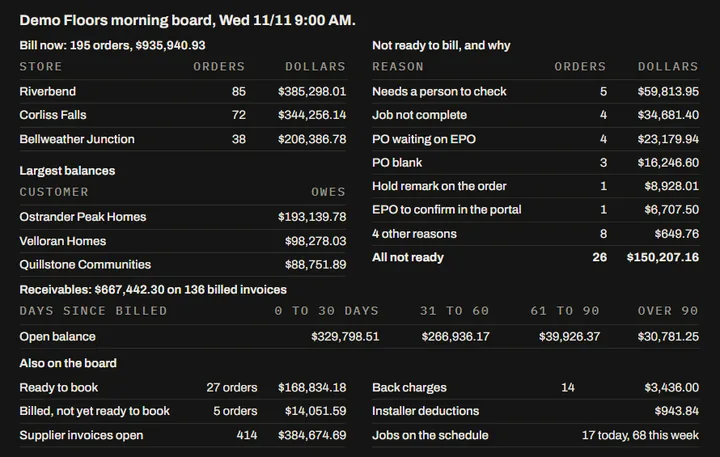 Demo company, fictional
Questions
How do we find completed work that was never billed?
Compare completed orders with billed orders as of one date: every order with a completed date and no bill date is earned but not billed. The free diagnosis does this on your exports and lists each order with its age and dollars.
What is cash application?
Matching each payment to the invoices it pays, line by line from the remittance, and recording any short amount with its reason. Until it is done, the aging shows paid invoices as open and open ones as paid.
Does Bearwall call or email our customers?
No. It shows what is open and why. Follow-up drafts are scoped in the diagnosis, and a person at your company reviews and sends them. It never sends money.
Start at A
A free diagnosis, one page back.
Send the exports your team already pulls. We aim to return one page within a week that reads them for you:
- Earned, not billed
- Billed, not booked
- Cash not applied
- Supplier invoices not keyed
- Receivables by age
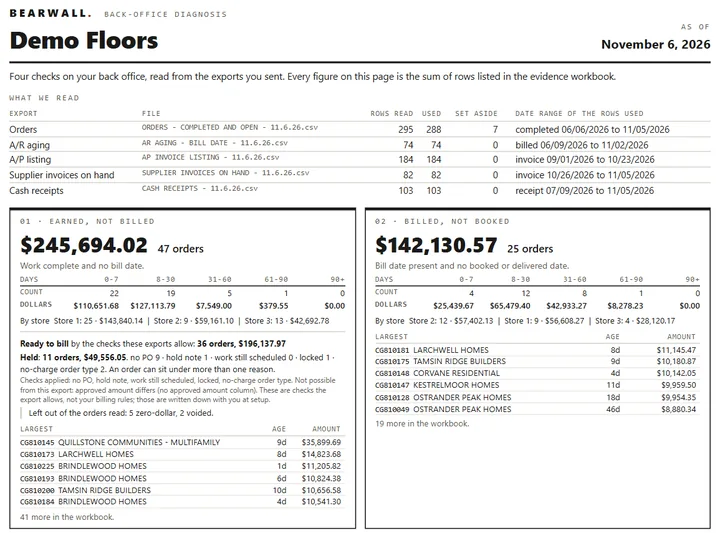 Sample page · fictional company