Supplier invoices and POs
Supplier invoices, matched three ways.
For flooring contractors who buy from mills and distributors: how a purchase order, a receipt and a supplier invoice should agree, where invoices go unkeyed, and how to catch a wrong price before it is paid.
The three-way match.
Before a supplier invoice is approved, three records should agree: the purchase order (what you ordered, at what price), the receipt (what arrived) and the invoice (what the supplier billed). Check the item, the quantity, the unit price and the extension. In flooring the units differ by product: roll goods by the foot or yard, hard surface by the carton, sundries by the each. A match that ignores the unit will pass an invoice it should hold.
Where supplier invoices slip.
- An invoice in someone’s inbox, never keyed, so payables and job cost are both short.
- The same invoice keyed twice, once from email and once from the mailed copy.
- A price above the PO, or a contract price that was never loaded.
- A partial shipment invoiced in full, or a backorder billed before it arrives.
- Freight or a fuel surcharge that was never on the PO.
- A return or a credit memo never taken against the next payment.
Purchase orders and receiving.
The match is only as good as the two records before it. A PO should exist for stock and job-specific orders, carry the job or order it belongs to, and be received when the material arrives, not when the invoice does. When receiving waits on the invoice, the match proves nothing.
What Bearwall sets up.
On your own system, set up for you and checked in a read-only month first:
- Supplier invoices keyed and matched to their PO and receipt.
- A mismatch in price, quantity or a repeated invoice number held for a person, with the reason.
- Supplier payment records for payments your team has made.
- An answer to “What do we owe suppliers?”, by age.
Your tolerance for small differences is a rule written with your team. Purchasing runs, receiving and EDI with suppliers are scoped in the diagnosis. Bearwall never sends money, and every write is checked before and read back after.
Questions
What is a three-way match?
A check that the purchase order, the receipt and the supplier invoice agree on item, quantity and price before the invoice is approved. A two-way match skips the receipt, so it can approve material that never arrived.
How do we find supplier invoices that were never keyed?
List the invoices on hand, from email and the desk, and compare them with the A/P listing in your system by supplier and invoice number. The free diagnosis does this on your files and flags numbers keyed at a different amount.
Does Bearwall pay suppliers?
No. It never sends money. Your team pays suppliers as it does today; Bearwall can record those payments in your system and keeps every invoice it holds in front of a person until it is settled.
Start at A
A free diagnosis, one page back.
Send the exports your team already pulls. We aim to return one page within a week that reads them for you:
- Earned, not billed
- Billed, not booked
- Cash not applied
- Supplier invoices not keyed
- Receivables by age
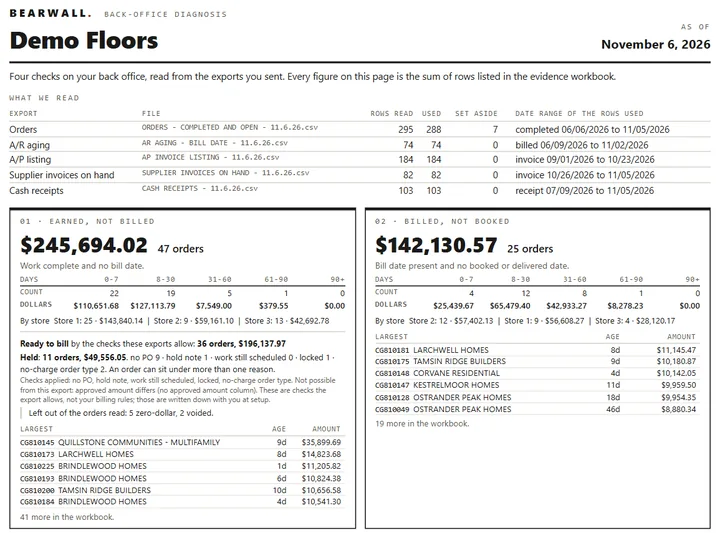 Sample page · fictional company